How Much Do Real Estate Agents Make in Ontario?

Residential real estate agents in Ontario earn a median of about $62,400 per year, with reported earnings ranging from $37,561 at the low end to $206,000 at the high end, according to Government of Canada Job Bank data (as of July 2026). Commission, splits, and expenses decide where you land.
That range is not a typo. Real estate is one of the few careers where two people with the same licence, in the same city, can earn five times apart. This article walks through the official numbers, how commission actually flows, what it costs to stay licensed, and what the first year genuinely looks like, so you can plan with real figures instead of Instagram ones.
What do the official numbers say?
According to the Government of Canada's Job Bank, residential real estate agents in Ontario earn a median of $62,400 per year. Reported earnings run from $37,561 at the low end to $206,000 at the high end (based on 2021 Census data, updated by Job Bank in November 2025, as of July 2026). Job Bank publishes annual rather than hourly figures for this occupation because most agents are self-employed and paid by commission, not salary. Nationally, the median is $58,400, so Ontario sits a little above the Canadian norm. Keep in mind these are gross earnings, before brokerage splits, licensing fees, insurance, marketing, and taxes, so take-home income is meaningfully lower than the headline number.
Here is how Ontario compares with the country as a whole:
| Level | Low | Median | High |
|---|---|---|---|
| Ontario | $37,561 | $62,400 | $206,000 |
| Canada | $32,867 | $58,400 | $178,000 |
Two things are worth reading into the spread. First, the low end includes a lot of part-time and barely active agents, which drags the median down. Second, the high end is not a cap; it is simply where the reported data thins out. Top producers in the GTA out-earn that figure, and plenty of licensed agents earn close to nothing in a given year. The median is the honest anchor: half of Ontario agents reported less than $62,400.
Where in Ontario do agents earn the most?
The regional breakdown surprises most people, because Toronto sits at the bottom of the list, not the top.
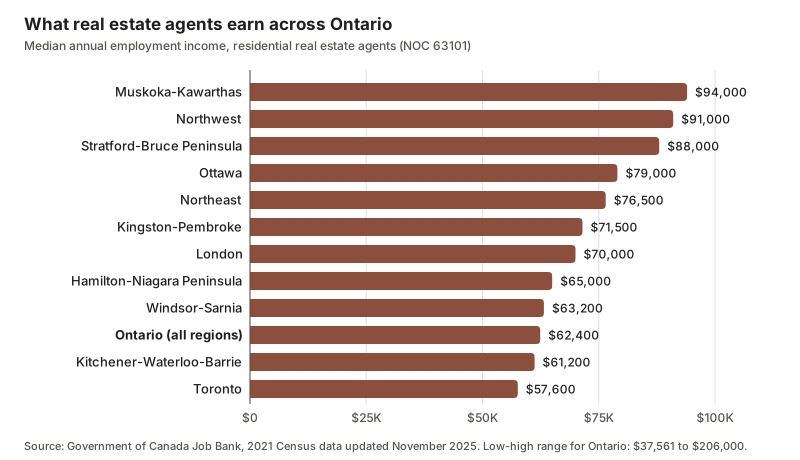
Toronto's median of $57,600 is the lowest of any Ontario region, while Muskoka-Kawarthas leads at $94,000 (as of July 2026, per Job Bank). The likely reason is simple arithmetic: the GTA has an enormous number of registrants, including many part-timers, all competing for a share of the same transactions. Higher home prices per deal do not help you if you close very few deals. Smaller markets tend to have fewer agents per active listing, so the agents who are there do more volume each.
The practical takeaway is not "move to Muskoka." It is that your income is driven far more by how many clients you serve than by the average price in your market. An agent with a deep database and steady referrals in Windsor will out-earn a struggling agent in downtown Toronto most years.
How does commission actually work in Ontario?

There is no set commission rate in Ontario. Rates are negotiable between the seller and the listing brokerage, and the total commission is typically shared between the listing brokerage and the buyer's brokerage. Your personal cut then depends on the split you have with your own brokerage, which varies widely by brand and by how much fee or desk cost you pay.
To make the flow concrete, here is a purely illustrative example. Every number in it is negotiable and none of it is a market statistic:
- A home sells and the transaction generates a gross commission.
- That gross amount is divided between the listing side and the buyer's side, per the listing agreement.
- Your side's share goes to your brokerage first, because commission is always paid brokerage to brokerage.
- Your brokerage takes its split or fee, then pays you the remainder.
- From that remainder, you cover your own expenses, HST remittance if applicable, income tax, and CPP contributions.
Two structural details catch new agents off guard. Commission is earned when the deal firms up but paid on closing, which is usually one to three months later. And because you are self-employed, nothing is withheld for you: the tax bill arrives later, so disciplined agents set aside a portion of every cheque the day it lands.
What does it cost to work as an agent in Ontario?

The gap between gross commission and take-home pay is where most income articles go quiet. Here is the realistic cost picture for a solo Ontario agent:
- RECO registration renewal: $350 every two years, per the RECO fee schedule (as of July 2026). The details of the process are covered in our guide to renewing your real estate licence in Ontario.
- RECO professional liability insurance: $500 plus applicable taxes per year for the September 2026 to August 2027 term, per RECO (as of July 2026).
- Board and association dues: membership in your local real estate board plus provincial and national association dues. Amounts vary by board, and they recur every year whether you close deals or not.
- Brokerage costs: monthly desk fees, transaction fees, or a percentage split, depending on your brokerage model.
- Marketing and lead generation: signs, photography contributions, ads, your website, and print. This is the most controllable line item and the one that quietly balloons.
- Vehicle, phone, and software: you drive more than you think, and subscriptions stack up fast.
Software deserves a special mention because it is where solo agents most often overspend, paying separately for a CRM, an email tool, a texting tool, and a website. Consolidating helps: CloseFlow was built for exactly this, bundling the CRM, automated follow-up, a unified email and SMS inbox, and a personal agent website into one predictable cost, so the expense side of your ledger stays boring.
The honest framing: several thousand dollars a year leaves your pocket before your first deal closes. That is normal, and it is manageable, but only if you budget for it like the business owner you now are.
What is the first year really like?
Plan for a slow start, financially. Between licensing, joining a brokerage, and building a pipeline, most new agents work for months before their first closing, and the commission from that closing arrives weeks after the handshake. A savings runway of six months of personal expenses is a common-sense cushion; twelve is more comfortable.
The encouraging part is that the slow start is a pipeline problem, not a talent problem, and pipelines respond to consistent work. If you are at the very beginning, our step-by-step guide to getting your first listing as a new Ontario agent covers the practical moves that shorten the gap. The pattern among agents who clear the median quickly is boring and repeatable: they treat everyone they know as a future client, they follow up on every conversation, and they track it all somewhere more reliable than memory.
One more first-year reality: your income will be lumpy for years. Two closings in March and nothing until July is a normal rhythm. Averages only smooth out once your database is large enough to produce steady referrals.
How do solo agents move up the income curve?
The agents who climb from the median toward the high end of the Job Bank range tend to do three unglamorous things well:
- They keep expenses lean. A dollar not spent on overlapping tools or vanity ads is a dollar of income at the same production level. Review every subscription and dues line annually.
- They build a repeat and referral engine. Past clients and sphere contacts cost nothing to serve and convert at far higher rates than cold leads. Systematic staying-in-touch beats sporadic prospecting every time.
- They protect their time. More income means more transactions, and more transactions mean ruthless prioritization of dollar-productive activities: conversations, appointments, and negotiations.
At some point, growing income raises the classic question of whether to hire help or join forces with others. We break down the trade-offs honestly in should a solo realtor build a team or stay solo, but the short version is that plenty of solo agents in Ontario out-earn team members by pairing a strong database with good systems and none of the overhead.
The bottom line on Ontario agent income: the median is $62,400, the spread is enormous, and which end of it you occupy has less to do with your market than with how consistently you generate, nurture, and close your own opportunities. Budget honestly, expect a slow first year, and build the boring systems early. The income follows the database.
Frequently asked questions
What is the average real estate agent salary in Ontario?
There is no salary. Agents are paid by commission, and Government of Canada Job Bank data puts the median at $62,400 per year in Ontario, with reported earnings running from $37,561 to $206,000. Those are gross figures before brokerage splits, licensing costs, insurance, and marketing.
Do real estate agents in Ontario get a base salary?
Almost never. Nearly all agents are self-employed commission earners registered with a brokerage. You are paid a share of the commission when a deal closes, and you cover your own expenses, CPP contributions, and income tax.
Why is the median income lower in Toronto than in smaller Ontario markets?
Job Bank data shows a $57,600 median in Toronto versus $94,000 in Muskoka-Kawarthas. Toronto has far more registrants competing for the same transactions, including many part-time agents, so the available commission pool is split across more people.
How much does it cost to keep a real estate licence in Ontario?
RECO's renewal fee is $350 every two years, and RECO's professional liability insurance is $500 plus applicable taxes per year, as of July 2026. On top of that you pay board and association dues, brokerage fees or splits, and your own marketing, vehicle, phone, and software costs.
How long does it take a new agent to earn a first commission cheque?
Commission is paid when a transaction closes, not when the offer is accepted, and closings are typically scheduled one to three months out. Add the time it takes to land your first client, and many new agents go several months, sometimes longer, before their first cheque. Plan your savings around that gap.
Sources
- Government of Canada Job Bank, Residential Real Estate Agent wages in Ontario (NOC 63101) (accessed July 2026)
- Government of Canada Job Bank, Residential Real Estate Agent wages in Canada (NOC 63101) (accessed July 2026)
- RECO fee schedule (accessed July 2026)
- RECO insurance renewal (accessed July 2026)